Monday, September 29, 2014

Post 8
Many people will agree that CEOs of companies make huge amounts of money in comparison to their peers and subordinates. However, what angers or frustrates many employees or stockholders in that company is that the CEO is offered bonuses for serving the interests of the company over the general welfare of people. But what if a system was created in which CEOs were incentivized for making decisions that are better for the environment and/or the general public?
There are many variations for this method to work and one, as stated in the textbook, is to have a board of directors that can hire and fire CEOs. This would keep the CEO levelheaded and prevent irrational actions or hasty judgments from the CEO because he or she would feel more pressure to “make a decision that benefits everyone.” Currently, CEOs have little to no obligation to make public goals a priority over company profits but with a board with such power, public interests will be in the back of his or her head when making decisions.
If there were companies in the modern age that try to serve the public interests’ to some capacity, it would be Google or Microsoft. Google has successfully put all the information in the world one click away. On the other hand, Microsoft has created software that is used in businesses, schools, and other institutions that contributes to other innovations. Both Google and Microsoft have done their fair share of trying to bring Internet access to under privileged countries and areas as well.
If CEOs were incentivized for decisions that benefited the general public and had less negative impact on the environment, corruption would also decrease significantly. If CEOs were compensated for making “excellent” decisions, they would not consider taking a risky alternative by accepting bribes and doing “under the table” dealings. Another advantage of this system is the fact that the overall image of a CEO would improve drastically. Right now, many think of CEOs as men or women in suits who do nothing but sit behind their desks all day and get in trouble for corruption or making decisions that negatively affect the employees or stockholders. If this CEO pay system were created, CEOs would go out of their way to improve the company and at the same time preserve the environment and satisfy the general public. CEOs would then receive their bonuses and the general public would be happy. This creates a win-win situation for all parties concerned.
Post 7
            It is often said that those who prepare for the worst will succeed more than those who expect the best every time. Similarly, in the modern age with countless innovations and endless research, it is important that humans place important emphasis on developing a method that would prevent unintended consequences or failure. Intelligent trial and error is the best way to ensure that, “the ratio of good to bad” (69) is high and there is more benefit for the world than harm.
            Intelligent trial and error should be implemented on all levels of innovation, particularly on those that could potentially impact the environment or other people. The first example of a situation in which intelligent trial and error was not applied and resulted in danger to health would be lead paint. From the image below one can see that before 1940, 87% of homes built were painted with lead paint, between 1940 and 1959, 69% of homes had lead paint, and between 1960 and 1977 24% of homes had it. Many died due to lead poisoning either by inhaling the toxic fumes over time, or if the lead entered the water flow because it was corroding from the pipes. A simple trial and error test could have prevented many deaths and kept the overall population safer.
Another example of where intelligent trial and error testing could have prevented consequences is with Chlorofluorocarbons (CFCs). CFCs were once often used as propellants in aerosol cans; however, scientists noticed that the ozone layer was becoming weaker at a faster rate. Scientists realized that CFCs in aerosol cans were the cause of this rapid increase, and when the Montreal Protocol came into force in 1989, CFCs were replaced in nearly every country due to the negative effects. If the scientists and engineers had collaborated and used trial and error testing while offering their respective inputs, this situation could easily have been prevented and our ozone layer, which protects us from harmful ultraviolet rays, would be stronger than it is today.
Based on examples from history and personal experience, the majority of consequences can be prevented by intelligent trial and error testing. From the examples above, it easy to realize that trial and error testing is effective and efficient given the proper investment of time and money. Despite the “three main pitfalls” (70) of trial and error testing, it is still the best option for preventing disasters and unintended consequences for humans and the environment.

Friday, September 19, 2014

Post 6
The question or topic I would like to focus on or address throughout this post is indirectly taken from the lecture on September 16th. The question is as follows, “Can the pace of technology be controlled? Are there more unintended consequences than some humans think there are?
My answer to the first question is yes and no. I say yes because if humans across the world wanted to create a group or delegate this responsibility they could in theory do so. However, I also say no because the selfish needs of every human being get in the way of forming such a group. Everyone expects to gain something when they contribute some input. For example, when rich alumni donate to their colleges, they expect some recognition whether it is in the school newspaper or something bigger like a building in his or her name. Similarly, if everyone formed such a group, it would be under immense pressure from corporations or other wealthy individuals who would want to influence and control it. If they had control over such a group, it would lead to more corruption and “under the table” pocketing of money. Eventually, this would lead to the dissolving of the group and end its ultimate purpose of regulating the development of technology.
Most humans around the world realize that the current rapid pace of technology has created unintended consequences. But, how many or to what extent have they been developing? For example, it is easy to see the technological gap between countries like America and third world countries. A significant population in the United States now owns a smartphone and almost everyone uses a computer at home or at work. However, in third world countries many do not even own a cell phone, and those who do, usually use a “flip phone” or something similar. Even computer use or Internet access is not as prevalent as it is in the western world. Therefore, a gap in technology leads to a difference in education and research simply because they cannot afford the newest things.
A solution to this issue would be to do “trial and error” testing. This basically means that before a product is released to the public, a committee or group conducts exhaustive tests on it to prevent as many consequences as possible. For example, before the upgrade to 4G LTE from 3G technologies, companies like Verizon and AT&T should have observed the effects in a small setting. These companies could have upgraded the service in medium sized town and then slowly upgraded the national network if little to no problems were detected. The pace of technology can be controlled if everyone wants it to be that way, but unfortunately companies and even some governments will oppose this proposition. 

Sunday, September 14, 2014

Post 5 (Edited Post September 18, 2014)
The question I would like to focus on or address throughout this post is indirectly taken from the lecture on September 12th. The question is as follows, “Are humans really happy without materialistic possessions? Do humans express genuine happiness when it is not related to some kind of object?”
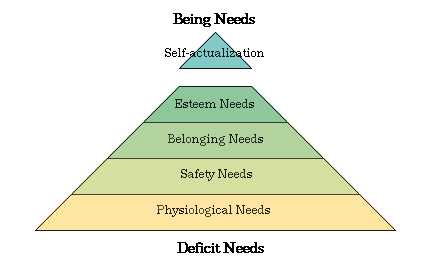
To begin this discussion I will begin with Abraham Maslow’s Hierarchy of Needs.
From this picture one can see that there is no true place for materialistic wealth. One can argue that expensive technology and other fancy gadgets could fall under “Esteem Needs” however that would imply that almost all humans are insecure since we all have some object that we feel is invaluable. This claim would not be suitable, otherwise even the most humble people would be considered insecure.
But in today’s world, it is nearly impossible to live a “21st century life” without materials or objects. For example, almost everyone has a house to live in, or uses some form of transportation that either they own, or the local government provides (local buses). Hence, living a life without completely removing or valuing materialistic possessions is unrealistic.
Generally the wealthiest nations will have the most material possessions, especially in comparison to third world countries. A study with more than 89,000 people in 18 nations revealed that 15 percent of people in high-income countries reported having been depressed, compared with 11 percent of those in low- or middle-income countries. Depression rates were highest in the United States and France, far outpacing poorer countries like Mexico (http://www.ibtimes.com/wealthiest-nations-are-unhappiest-study-818211). This means that material wealth does not equal happiness and humans should look beyond materialistic desires.
This leads me to the other question, which is, “Do humans express genuine happiness when it is not related to some kind of object?” For example, are humans truly happy distant family members came to their birthday party, or are they more interested in what gifts they received from them. Although this thought sounds negative and egocentric, it could be true. When was the last time you or even someone you know had a birthday party without expecting some present?
I also think technology is to blame for how materialistic humans have become. It is developing at the fastest rate in history and the general public is not able to keep up with the latest phone or computer. This fast pace leads to greed for more new gadgets during birthdays and similar events. Unfortunately, the newer devices have slight upgrades on the previous models, which always leave us for wanting more.

I do not see how this problem can be solved in the near future, or if it is even considered a problem by other humans. Perhaps I am blowing this issue out of proportion and I should think about how difficult life would be without technology and materialistic wealth. Sure, this viewpoint is valid, but there has to be a clear line when materialistic appreciation or desire becomes unhealthy and an obsession.
Post 4 (Edited Post September 18, 2014)
The question I would like to focus on or address throughout this post is indirectly taken from Chapter 5. The question is as follows, “Is technology developing at a pace that is too fast? Should we slow it down? In what cases (criteria)?”
            My simple answer to the first part of the question would be “yes”. In the recent past, there have been countless inventions and new technologies that have been introduced to the public. For example, in 2007, we had the unveiling of the iPhone and since then we have had a new model almost every year. Besides that, Apple also releases “s” and “c” models of their popular phones, which pushes for rapid development. Companies that create and sell “newer” technologies contribute to the intense pace that it is at now.
            An example of customer frustration towards the pace of current technology related to the case mentioned above about the iPhone. I know that most of my friends own a smartphone, more specifically an iPhone, and feel that each upgrade from generation to generation of smartphones is so small that sometimes they do not want to purchase the newest iPhone. However, society often pressures us into doing things against our will. But, companies like Apple are to blame as well. When a new iPhone is released, often the previous generation will stop receiving software updates, and many times users have reported compatibility issues with iTunes and other apps that they once were able to use, but now cannot because of the newer generation.
            I believe technology needs to slow down. Besides the inconvenience of transferring data to new devices, the expensive of keeping up with the latest gadgets is too great for most around the world. Financially speaking, buying a new laptop every year is simply too expensive and most of the time, there are slight improvements in processing power or display quality. Also, I have found myself frustrated with newer technology sometimes, especially when the product begins asking if you want to sign up for this promotion, or this service, etc. Therefore, newer technologies are sometimes unnecessary and even a little counterproductive.

            Does everything I mentioned above imply that I do not want technology to progress at all? And that everything should come to a standstill? No, because regardless of what one may think of the newest phones, developments in alternative fuels and technologies should continue at the current rate or even increase. Likewise, health care technologies should continue to improve. There are many good examples to argue that the pace of technology should continue as it is now, but it should be limited in some areas.

Sunday, September 7, 2014

Post 3 (Edited Post September 19, 2014)
In this post I would like to focus on the unequal distribution of technology from the September 2nd lecture and the “Is Google Making Us Stupid?” article. Professor Breyman provided insightful data and information on his PowerPoint regarding the usage of technology across the globe and I would like to take that thought one step further and raise questions about whether or not people without Internet access are “smarter” than those who do use it.
As Professor Breyman stated, “Wonderful benefits of technoscientific innovation are NOT distributed equally, either domestically or globally” (Slide 3 of 9/2 lecture). Which implies that despite our attempts to “level the playing field”, there is still quite a significant portion of the world’s population that does not have access to the Internet. Some benefits of the Internet include instant news, various forms and tools for communication (Facebook, email) and even a sense of community amongst Internet users. In fact, “Fewer than 1 ½ billion or so (out of seven billion or so people on the planet) regularly realize these benefits” (Slide 3 of 9/2 lecture).
But is having access to Internet always a good thing? Recent studies have shown that people become depressed and experience severe emotional changes with heavy computer usage. Similarly, the notion that having so much access to information at our fingertips might be making us more “stupid” should also put off those in the “global middle class”. In China and India, unprecedented growth on all fronts has led to more demand for technology and if current trends continue, they should be joined by millions of more people around the world.
As I was listening to the lecture in class, I asked myself if those who have never used the Internet have sharper brains or are “smarter” than Internet users. Although there are no studies that I am aware of, there must be some difference in mental capacity. It would be difficult to accurately test this however, because usually “studies” are very “Western-centric” and would probably fall short due to differences in cultures. Similarly, people in the West view intelligence and mental capacity in a different light as opposed to how the East views these two qualities. Obviously there are the emotional and advantages of not using the Internet as that person would be less likely to suffer from depression. But I believe that there is a difference in memory because those who use technology to write down almost everything they need to do or get such as grocery lists or taking out the trash.