Post 5
The question I would like to focus on or
address throughout this post is indirectly taken from the lecture on September
12th. The question is as follows, “Are humans really happy without
materialistic possessions? Do humans express genuine happiness when it is not
related to some kind of object?”
To begin this discussion I will begin
with Abraham Maslow’s Hierarchy of Needs.
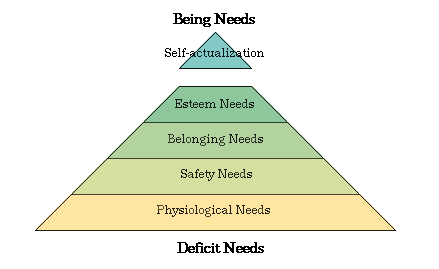
From this picture one can see that there
is no true place for materialistic wealth. One can argue that expensive
technology and other fancy gadgets could fall under “Esteem Needs” however that
would imply that almost all humans are insecure since we all have some object
that we feel is invaluable. This claim would not be suitable, otherwise even
the most humble people would be considered insecure.
But in today’s world, it is nearly
impossible to live a “21st century life” without materials or
objects. For example, almost everyone has a house to live in, or uses some form
of transportation that either they own, or the local government provides (local
buses). Hence, living a life without completely removing or valuing
materialistic possessions is unrealistic.
Generally the wealthiest nations will
have the most material possessions, especially in comparison to third world
countries. A study with more than 89,000 people in 18 nations revealed that 15
percent of people in high-income countries reported having been depressed,
compared with 11 percent of those in low- or middle-income countries.
Depression rates were highest in the United States and France, far outpacing
poorer countries like Mexico (http://www.ibtimes.com/wealthiest-nations-are-unhappiest-study-818211).
This means that material wealth does not equal happiness and humans should look
beyond materialistic desires.
This leads me to the other question,
which is, “Do humans express genuine happiness when it is not related to some
kind of object?” For example, are humans truly happy distant family members
came to their birthday party, or are they more interested in what gifts they
received from them. Although this thought sounds negative and egocentric, it
could be true. When was the last time you or even someone you know had a
birthday party without expecting some present?
I also think technology is to blame for
how materialistic humans have become. It is developing at the fastest rate in
history and the general public is not able to keep up with the latest phone or
computer. This fast pace leads to greed for more new gadgets during birthdays
and similar events. Unfortunately, the newer devices have slight upgrades on
the previous models, which always leave us for wanting more.
I do not see how this problem can be
solved in the near future, or if it is even considered a problem by other
humans. Perhaps I am blowing this issue out of proportion and I should think
about how difficult life would be without technology and materialistic wealth.
Sure, this viewpoint is valid, but there has to be a clear line when
materialistic appreciation or desire becomes unhealthy and an obsession.

No comments:
Post a Comment